Stop explaining the same things to your AI every day.
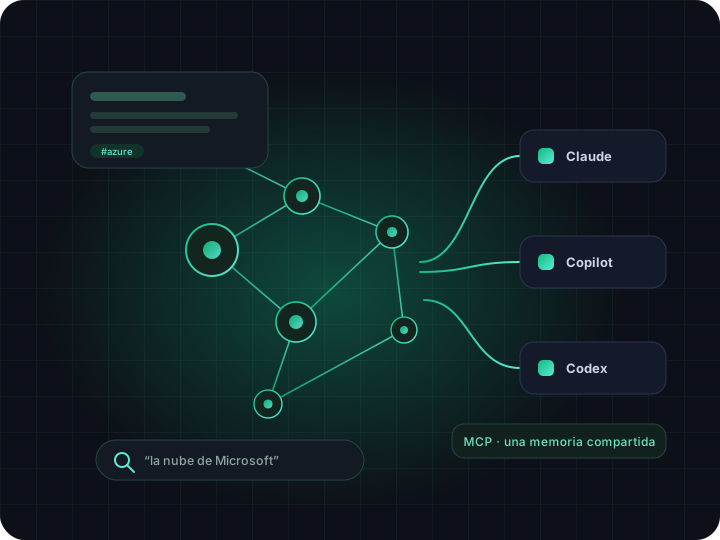
Diluxite is not another note editor: it is the memory your AI reads, writes and searches by meaning. Store knowledge once and Claude, Copilot, Codex and any MCP client recall it across sessions and across tools.
A loose .md file cannot do this: your AI can neither remember it nor search it semantically.
Hybrid search: “the Microsoft cloud” finds your note about Azure.
Ten native MCP tools, no adapters and no glue code.
All of DiluxOne is in private preview. Registering is free, asks for no card and commits you to nothing.
What you get
Knowledge that accumulates instead of evaporating
Your AI remembers your context
Decisions, notes and projects stay available without re-explaining everything in every new session.
Search by meaning
Hybrid: keyword and semantic combined, fused with RRF. You can force keyword-only or semantic-only whenever you need to.
Wikilinks, backlinks and graph
Markdown notes that link to each other, with a graph view and tags to navigate what you have built.
One memory, all your agents
Native MCP server with ten tools: search, read, write, append, list, backlinks and more.
Live collaboration
Real-time collaborative editing with cursors, presence and conflict-free merges. Multi-user by workspace.
Corporate-grade security
OIDC SSO, passkeys, TOTP 2FA, audit log with retention and per-workspace isolation.
How it connects
The same brain for all your tools
Diluxite exposes a native MCP server with per-user tokens. Connect your agents once and they share a single persistent memory — what Claude wrote yesterday, Copilot reads today.
Core edition, open sourceAGPL-3.0, self-hosted, with a smart installer and a management menu: update, reconfigure, backup, restore and uninstall.
Cloud editionMulti-user and hosted, built on exactly the same engine. Not a different product wearing the same name.
Six UI languagesSpanish, English, Portuguese, Italian, Catalan and Chinese.
Trash with soft deleteRestore or purge notes, with a per-workspace trash view.
Solid stackNode + TypeScript, Fastify, PostgreSQL with pgvector, React. Over 850 tests green.
In action
A second brain that actually looks like one
Real captures over a workspace with 1,492 notes. This is what knowledge looks like once it stops being scattered.
Your spaceYour memory, measured1,492 notes, 30 folders, 60 tags, 625 wikilinks. Not a folder of loose files: a body of knowledge with structure, and that panel tells you how much it has grown.EditorMarkdown on the left, the result on the rightA real ADR with tags, status, context, decision and alternatives. The [[wikilinks]] connect to other notes and generate backlinks on their own: next time, your AI gets there without being told.GraphYou can see where the knowledge concentratesThe 1,502-node graph shows the real clusters: here, every postmortem hanging off a Knowledge Hub. When something repeats three times in the graph, it stopped being an incident and became a pattern.SearchIt finds what you meantSearch “azure” and 14 matches across 14 notes show up, with the snippet and tags highlighted. And semantic search goes further: it finds the note even if you typed “the Microsoft cloud”.MCP connectionConnect your AI in two clicksGenerate a named token with an expiry, paste it into Claude or Copilot, and done: your agent can now read from and write to your memory. Tokens are revoked one at a time or all at once.OrganizationAnd when the brain belongs to the whole teamMembers by email with roles, workspaces with isolation, org tokens, embedding configuration and an audit log. What it takes for a second brain to be corporate rather than an experiment.
Pricing
From personal use to your organization’s brain
Start on your own for a hundred dollars a month, or give your whole company one shared memory.
Tell us whether it is for you or for your organization and we will enable your space. You can also start self-hosted today.
Free, and no credit card.
We email you as soon as a seat opens.
Meanwhile you can keep using the open source edition.
Done — your request is registered.
You are on the private preview list. We will email you at the address you provided as soon as a seat opens.
Request number: —
Frequently asked questions
How is this different from a folder of Markdown files?
Your AI can use it on its own. A loose .md cannot be searched by meaning and is not remembered across sessions; Diluxite exposes the memory over MCP, with hybrid search, links and permissions.
Which AI clients can I connect?
Any that speaks MCP: Claude, Copilot, Codex and the rest of the ecosystem. Each user gets a token and they all share the same memory.
How are documents counted?
The Personal plan includes up to 1,000 documents, plenty for intensive individual use. The Organization plan has no document limit.
Do my notes get locked in?
No. They are Markdown, the Core edition is open source, and you can export or move to self-hosted whenever you want.