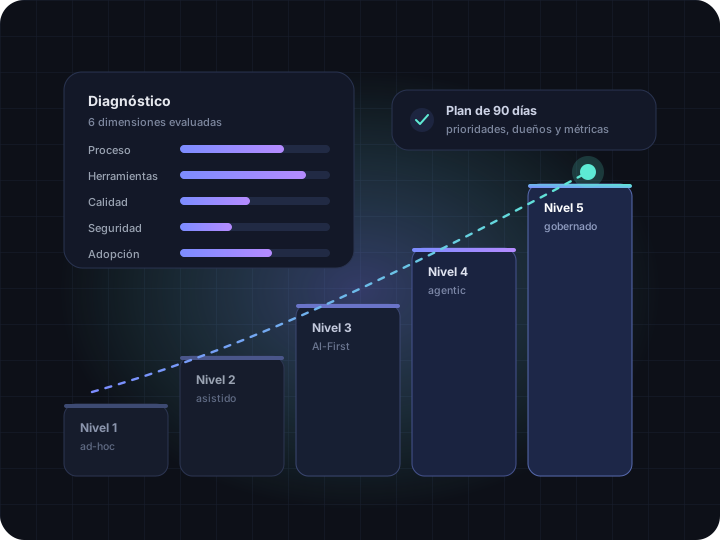
Your team already uses AI. The question is how much of that is method and how much is luck. We measure where you stand today, define where it makes sense to get to, and walk with your team until this is how they work every day.
A maturity assessment across 6 dimensions and 5 levels, based on evidence rather than impressions.
The three flavors of agentic development — high, medium and low human-in-the-loop — and when each one fits.
A 90-day plan with priorities, owners and metrics. A pilot with a real team before scaling.
Not all agentic development is the same agentic development
The difference is how much human intervention sits in the middle. It is not a ladder where the top rung is the good one: each level is the right answer for a kind of work, and a mature organization runs all three.
High HITL
A person approves every step
Human intervention: high · Speed: moderate · Risk: minimal
The agent proposes and a person reviews and approves at every transition: the requirement, the design, the code, the release. It is the natural starting point, because it builds trust with evidence rather than with promises.
Explicit approval at every phase
Ideal for the first three months of adoption
Builds the corpus of decisions that later makes automation possible
Where it fits: critical systems, regulated domains, teams just getting started.
Medium HITL
A person decides at the points that matter
Human intervention: medium · Speed: high · Risk: controlled
The agent walks the pipeline on its own and stops only at the gates you defined: the approved spec, the threat model, the verification verdict. Everything else moves without anyone having to watch.
Gates enforced by code, not by good intentions
Automatic audit by an agent that did not write the code
This is how Dilux Agentic Workflow works
Where it fits: the bulk of product development in a trained team.
Low HITL
A person sets the goal and reviews the outcome
Human intervention: low · Speed: maximum · Risk: bounded by design
You define what has to be achieved and the flow runs end to end — from PRD to pull request — with a person stepping in only if something leaves the boundaries. It requires a process that already works: automating a broken process only breaks it faster.
Complete flows executed and observed end to end
Explicit boundaries, token budget and stop criteria
Fully traced: what ran, with which model, at what cost
Where it fits: repetitive, well-bounded work with clear acceptance criteria.
Part of our job is telling you which of the three fits each kind of work in your organization — and why forcing the third one too early is the most expensive way to fail.
The assessment
First we measure. Then we have opinions.
We evaluate six dimensions against five maturity levels, looking at real artifacts: repositories, pull requests, pipelines, incidents and how your team actually works today. The output is a map, not a slide deck.
ProcessHow is the work defined, and what evidence of that decision survives?
ToolingWhich agents are used, how are they configured and who decides that?
QualityTests, code review, acceptance criteria and what happens when something fails.
SecurityThreat modeling, SAST, secret handling and agent permissions.
AdoptionHow many people genuinely work this way, and what holds the rest back.
GovernanceCost, traceability, audit and who answers for what an agent produced.
How we work
Four stages, results in each one
No endless projects: every stage delivers something your team can use even if you decide to stop there.
01
Assessment · 2 to 3 weeks
Interviews, repository review and observing how the team actually works. Deliverable: a maturity report per dimension, with the current level, a realistic target and prioritized gaps.
02
90-day plan
What changes, in what order, who owns each item and how it is measured. Includes deciding which kind of work goes to high, medium or low human-in-the-loop.
03
Pilot with a real team
We roll the method out on a product that already exists, with Dilux Agentic Workflow installed in its repos. One team, one quarter, metrics before and after. No laboratories.
04
Scale and governance
We take what worked to the rest of the organization, with training, your own templates, gates tuned to your policies, and a cost and traceability dashboard.
What you take away
Concrete deliverables, not impressions
Maturity report
Current level per dimension, with evidence. Useful to justify the investment upward and to measure progress six months later.
90-day plan
Priorities, owners, milestones and metrics. What cannot be measured cannot be scaled.
Pipeline installed
Dilux Agentic Workflow running in your repos, with phases and gates adapted to your quality and security policies.
Your own guardrails
Your organization’s AGENTS.md: your stack, your architecture conventions and your domain glossary, written the way an agent reads them.
A trained team
Your people able to run the method, not depending on us to do it. That is the explicit goal of the engagement.
Governance dashboard
Cost per team and per flow, traceability of what each agent produced, and an audit trail ready to show.
Who is behind this
About us
We do not sell a theory: we ship to production the very thing we teach.
Pablo Ariel Di Loreto
Creator of DiluxOne · Microsoft MVP in Azure & AI
Pablo is the creator of DiluxOne and the author of its four software solutions: Dilux Agentic Workflow, Diluxite, DiluxClaw and WordPress Plugins. These are not products commissioned to a third party: every design decision, every gate and every architectural line came out of his own work building software with AI.
With over twenty years in software engineering and experience leading teams that build and operate systems at regional scale, he brings to every engagement what he learns shipping AI-First solutions to production: agentic development, architecture decisions, real cases and the challenges of deploying AI in the real world.
Consulting and training services are led by Pablo and delivered by his independent team of professionals, a dedicated structure of its own working exclusively on DiluxOne. Every engagement is agreed by contract, with defined scope, timeline and deliverables.
Creator of all four DiluxOne software solutions
Microsoft MVP in Azure & AI
Secretary of the Microsoft User Group Argentina
Instructor of the AI-First Builders Lab program
Independent team of consultants delivering the engagements
Consulting
Let us start by knowing where you stand
Tell us your team size and how you work today. We will come back with a concrete assessment proposal.
First conversation at no cost and no commitment.
Proposal with scope, timeline and a closed price.
We work 100% remotely, with your team wherever it is.
Done — your request is registered.
You are on the private preview list. We will email you at the address you provided as soon as a seat opens.
Request number: —
Frequently asked questions
Do we have to use DiluxOne products?
No. The method is agnostic and we work with whatever agent and stack you already have. That said: if Dilux Agentic Workflow fits, it is open source and free, so there is no reason not to use it.
How long does it take?
The assessment takes two to three weeks. The pilot, a quarter. Scaling depends on the size of the organization. Each stage closes with its own deliverables: you can stop wherever you want.
Do you work with teams that do not use AI yet?
Yes, and it is often the best moment: there are no habits formed without method to undo. Level 1 is a legitimate starting point.
How is it priced?
By scope and team size, with a closed price per stage. The first conversation is free.